
Getting testnet tokens
Request free TRX and TRC-20 test tokens through the Shasta and Nile faucets or the TronFAQBot on Telegram and Discord.
This guide walks through getting testnet tokens (TRX and TRC-20 tokens) on the TRON Shasta and Nile testnets. These free tokens let you test smart contracts and DApps at zero cost.
Methods for getting testnet tokens
Faucet websites
The most direct way. Steps:
-
Prepare your wallet address. In your TRON wallet (such as TronLink), switch to the Shasta or Nile testnet and copy your wallet address. To create a new wallet:
- Follow the TronLink guide for step-by-step instructions.
- See Accounts and keys for the underlying technical model.
-
Open a faucet website. In your browser:
- Nile Testnet: https://nileex.io/join/getJoinPage
- Shasta Testnet: https://shasta.tronex.io/join/getJoinPage
-
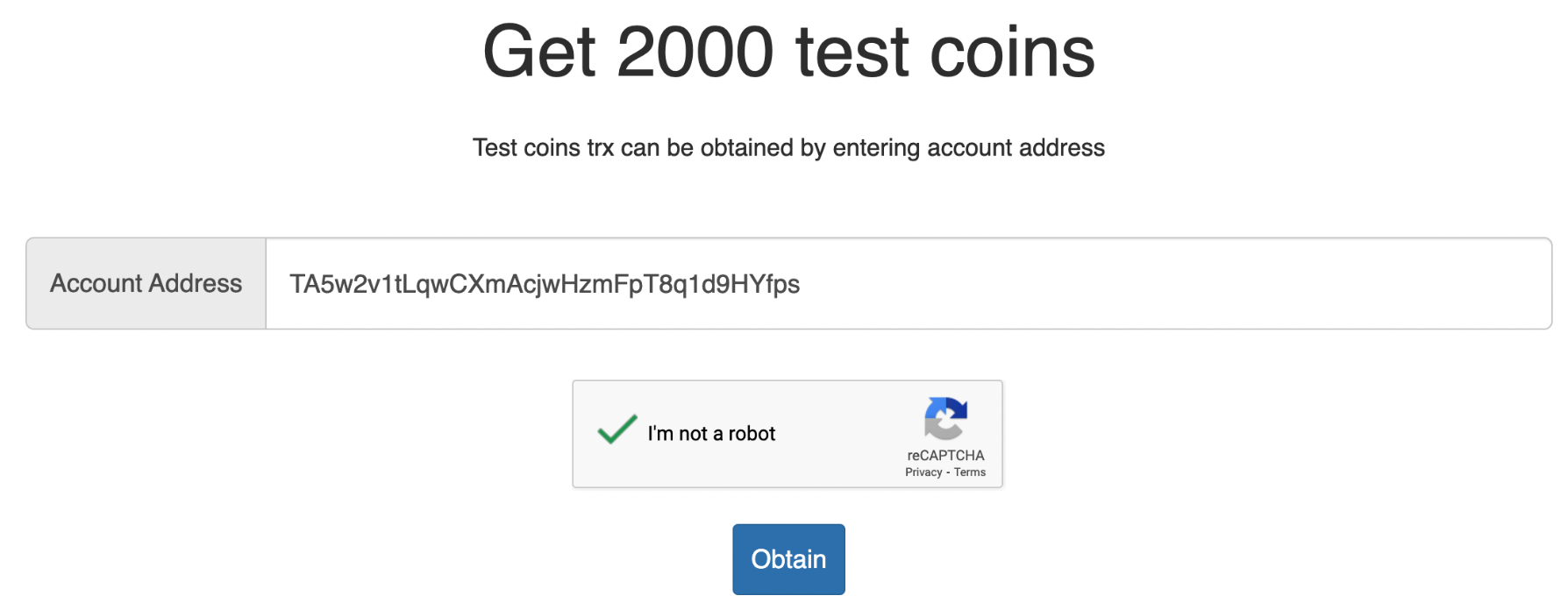
Request tokens. Paste your wallet address into the input field, complete the reCAPTCHA, and click Obtain.
-
Read the status response. The faucet replies with a popup. The three common responses:
- Success — "Successful acquisition of test tokens." The faucet broadcasts the transfer; allow a few seconds for confirmation.
- Already claimed — "You have acquired test tokens today and cannot be retrieved repeatedly!" You hit the 24-hour cooldown for this token. Wait for it to reset.
- Invalid address — "Failed to get test tokens, please enter the address in the correct format!" The address is not a valid TRON Base58 address. Double-check what you pasted.
Important notes
- Daily limits. Each wallet and IP address can request once per 24 hours per token. The amount per request varies; check the faucet page for current values.
- Verify URLs. Faucet domains can change over time. Always reach the faucet from official documentation or a verified developer community — never from a forwarded link.
TronFAQBot on Telegram and Discord
You can also request testnet tokens through the TronFAQBot in TRON developer chat groups.
-
Join a developer community. TronFAQBot lives in the following groups:
- Telegram:
- TRON Developer Group: t.me/TronOfficialDevelopersGroupEn
- TRON Core Devs Community: t.me/troncoredevscommunity
- Discord: discord.com/invite/hqKvyAM
- Telegram:
-
List bot commands. In the group chat, send
!help:Available Commands Replace <address> with your TRON address. Do not add any other text. Nile Faucet !nile <address> — Request Nile TRX !nile_usdt <address> — Request Nile USDT !nile_usdc <address> — Request Nile USDC !nile_usdd <address> — Request Nile USDD Shasta Faucet !shasta <address> — Request Shasta TRX !shasta_usdt <address> — Request Shasta USDT !shasta_usdc <address> — Request Shasta USDC !shasta_usdd <address> — Request Shasta USDD Utilities !balance <address> — Check address balances !check <address> — Validate an address !ping — Check bot status !help — Show this message Limits 2,000 per token on each network every 24 hours. -
Request tokens. Send a command in the format
!<command> <your_wallet_address>. For example:# Request 2000 TRX on Nile testnet !nile TA5wVDny...1k8PvfYZ # Request 2000 USDT on Shasta testnet !shasta_usdt TA5wVDny...1k8PvfYZTronFAQBot replies with a confirmation message such as
<username> will receive 2000 TRX (Shasta) soon. Thank you!Verify the transaction by checking your wallet balance.
Security best practices
Whatever method you use, follow these principles:
- Use a dedicated test wallet. Create a fresh wallet for testing only. Never import a Mainnet private key or mnemonic phrase into a test environment — testnet tooling is sometimes less hardened than Mainnet, and a leaked key on Mainnet would mean real losses.
- Treat testnet keys carefully too. Even though testnet tokens have no value, careless habits with testnet keys carry into Mainnet behavior. Practice good key hygiene from day one.
- Use testnet tokens for testing only. Testnet tokens have no financial value and should never be traded.
- Verify transactions on-chain. Use the testnet TronScan to confirm balances, transaction details, and contract behavior:
- Nile: nile.tronscan.org
- Shasta: shasta.tronscan.org
Need more testnet tokens?
The 2,000-per-token daily limit covers most testing if you use what you already have efficiently. Before assuming you need a larger allocation, work through the strategies below — they are repeatable, free, and improve your test infrastructure rather than depending on a one-off handout.
Use the precision you already have
Precision is asset-specific: TRX, USDT, and USDC use 6 decimal places, while USDD uses 18. A TRC-10 token can set precision from 0 through 6, and a TRC-20 contract defines its own decimals() value. At 6 decimals, 2,000 tokens equals 2,000,000,000 atomic units. Many tests that run out of tokens simply use amounts that are larger than the behavior under test requires.
Reduce per-test amounts: 0.001 TRX is still 1,000 sun, plenty for exercising a transfer flow. Audit your test fixtures and replace transfer(1000) style calls with transfer(0.001) where the test logic does not require a specific magnitude.
Recycle TRC-20 tokens after each test run
TRX is consumed when it burns to pay Bandwidth or Energy. TRC-20 tokens — including the USDT, USDC, and USDD on Nile and Shasta — only move between addresses; they do not disappear unless the contract has an explicit burn function and your test calls it.
Build a teardown step into your test harness: at the end of a test, sweep all test-output addresses back to a treasury address you control. The same 2,000 USDT can support thousands of test cycles when reused this way.
Stake TRX to reduce per-transaction burn
Staking TRX on testnet grants the address Bandwidth and Energy, which recover over time. For an ordinary transaction, staked Bandwidth must cover the whole transaction; otherwise the network tries free Bandwidth and, if that also cannot cover it, burns TRX for the full Bandwidth requirement. Available Energy can be used first, with TRX burned for the remaining Energy cost.
A small stake on a test address quickly pays for itself in extended test runs. Stake 2.0 works the same on Nile and Shasta as on Mainnet — see Stake and delegate resources for the recipe, and Resource model for the math behind Bandwidth and Energy.
Deploy your own test token
For custom amounts, custom token economics, or supply that does not fit the faucet's allocation, deploy a TRC-20 (or TRC-10 / TRC-721) of your own on testnet. You choose the total supply at deployment and you own all of it from minute one.
See Token standards overview for the standards and Deploy a TRC-20 token for a copy-paste deployment recipe.
Estimate Energy before broadcasting
Failed contract calls still burn Energy — and so burn TRX. Use triggerconstantcontract or estimateenergy to predict Energy consumption before broadcasting a real transaction. Catching a misconfigured fee_limit or a contract revert before spending costs nothing; doing it after is paid in burned TRX.
For the full debugging endpoint catalog, see Errors and debugging.
Run a private testnet
For long-term, high-volume, or fully controlled testing — running thousands of transactions per minute, simulating a market, testing chain forks, or doing chaos-engineering experiments — deploy your own private TRON network. You set the genesis allocation and every chain parameter, so token supply is no constraint.
See Building a TRON private chain.
Related resources
- Accounts and keys — the TRON account model
- Tokenomics — TRX supply, distribution, and the role of the native token
- Security and scam prevention — security best practices on TRON
Updated 3 days ago